Chacko and Margaret Kochamma’s marriage
The God of Small ThingsChacko and Margaret Kochamma’s marriage is presented through its aftermath: a divorce, a daughter who connects them, and incompatible family explanations of whether Chacko had loved Margaret Kochamma. When Joe’s death brought Margaret Kochamma and Sophie Mol to Ayemenem for Christmas, their return placed the former spouses together again. At Sophie Mol’s funeral, Margaret Kochamma would not let Chacko comfort her, a small but decisive gesture that set grief beside the unresolved distance between them.
Marriage and Separation
Chacko is identified as Sophie Mol’s biological father and Margaret Kochamma as her English mother; they are also described as former spouses. Their marriage had therefore ended before the events surrounding Sophie Mol’s visit, but their family connection remained active through their daughter. The available account does not detail how the marriage began, why it ended, or when the divorce took place, so the relationship is chiefly legible in the obligations and interpretations that survive its dissolution.
That surviving connection shapes what follows. Chacko’s invitation to Margaret Kochamma and Sophie Mol was not an abstract family courtesy: it brought his former wife and daughter from London to spend Christmas with his family in Ayemenem. Their shared history made the visit a reunion of a divided family, while the circumstances that occasioned it—bereavement in Margaret Kochamma’s household—gave the invitation a note of compassion and loss.
The Christmas Invitation
Earlier that year, Joe, Margaret Kochamma’s second husband, had been killed in a car accident. On hearing of Joe’s death, Chacko invited Margaret Kochamma and Sophie Mol to Ayemenem, explaining that he could not bear to think of them spending Christmas alone in England, in a house full of memories. The invitation thus followed a specific bereavement and offered a change of setting: Margaret Kochamma and Sophie Mol would spend the holiday with Chacko’s family rather than remain in England with the reminders of Joe.
For Estha and Rahel, Sophie Mol’s arrival was anticipated before they had met her. They had heard about their cousin during the preceding week from Baby Kochamma, Kochu Maria, and Mammachi, who spoke as though they already knew her. The family’s expectation gathered around the question of what Sophie Mol might think. This anticipation places the visit in a wider family dynamic: Chacko’s past marriage was not private history alone, but the route by which a new cousin entered the children’s world and altered the household’s attention.
Conflicting Accounts of Love
The family does not offer a single account of Chacko’s feelings for Margaret Kochamma. Ammu said that Chacko had never stopped loving her. Mammachi disagreed, and preferred to believe that he had never loved Margaret Kochamma in the first place. The contrast is not resolved by an explanation of the marriage; instead, the former spouses’ history reaches the reader through competing interpretations voiced by other family members.
These claims also make the marriage’s emotional past a matter of family narration. Ammu’s version gives the continuing invitation the shape of enduring love; Mammachi’s preferred version denies that love existed from the outset. Neither statement is presented as a definitive account of what Margaret Kochamma or Chacko privately felt. What the narrative establishes is that the family reads the same relationship in opposing ways, and that Chacko’s connection to his former wife remains consequential enough to be argued over.
Shared Grief and Distance
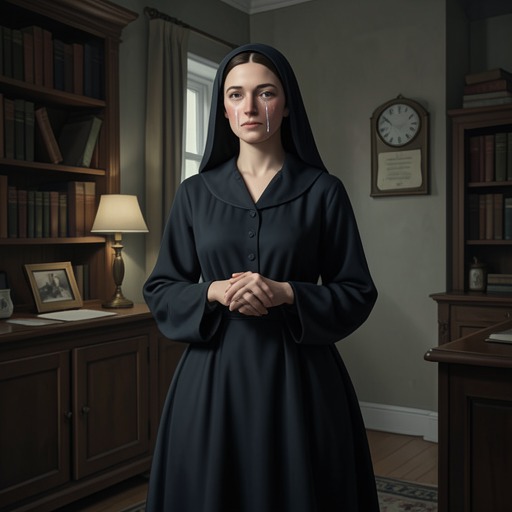
The relationship’s unresolved distance becomes concrete at Sophie Mol’s funeral in Ayemenem. Margaret Kochamma would not let Chacko put his arm around her to comfort her. The moment brings the former spouses together in the presence of their daughter’s death, yet denies the gesture of consolation that might have suggested renewed intimacy. Their shared loss does not erase the boundary between them.
The family gathering sharpens that contrast. Mammachi, Chacko’s mother and Sophie Mol’s grandmother, was nearly blind and wore dark glasses outside the house; her grief over Sophie Mol was bound up with distress at seeing her son devastated. Ammu, Estha, and Rahel were permitted to attend but made to stand apart from the rest of the family, and no one looked at them. The funeral thus reveals not only Margaret Kochamma and Chacko’s separation, but the divisions surrounding the family’s grief. Margaret Kochamma’s refusal of comfort remains a restrained, visible sign of the marriage’s afterlife: their daughter joined them in kinship and loss, but did not restore their former closeness.
Narrative Significance
The marriage is defined less by a narrated courtship or divorce than by what persists after it: Sophie Mol, Chacko’s invitation following Joe’s death, and the family’s disagreement about whether Chacko had loved Margaret Kochamma. This indirect presentation leaves the former spouses’ private history largely unstated while showing how others interpret it and how its consequences re-enter family life.
That structure makes the funeral gesture especially telling. Chacko’s offer of comfort and Margaret Kochamma’s refusal condense the difference between continuing family ties and renewed marital intimacy. The relationship has not vanished with the divorce, but its remaining bond is shaped by their daughter and by loss; the account does not turn that bond into a reconciliation.